Technical information
Stretch ceiling technical specifications
Reference data for the films, light sources, diffusers and structures used in stretch ceilings, kept in one place.
Stretch ceilings were invented in Europe in 1969. The figures below are reference data from the manufacturer catalogue for the product families we work with.
Supplier reference data from the manufacturer catalogue. Figures vary by product, batch and project, so we confirm the exact specification in writing with your quote.
Membrane
Stretch fabric
UV printing cures the ink instantly under ultraviolet light, which gives sharp print quality, fast drying, durable results and a wide range of printable materials.
| Material | PVC stretch film |
|---|---|
| Chemical composition | 74% PVC, 26% plasticiser |
| Thickness | 0.18 mm |
| Weight | 240 g/m² |
| Width | Up to 5 m |
| Maximum tensile strength | Up to 17 MPa |
| Elongation at break | 262% |
| Light transmission (translucent film) | 75% |
| Ambient temperature range | +5 °C to +40 °C |
To be confirmed: The catalogue prints the fire-retardant film grade as "BS100"; this is probably "B-S1-D0" and is to be confirmed.
To be confirmed: The mirror film data sheet gives 0.19 mm for a different film at the same 240 g/m².
Lacquer film colours include white, black, red, yellow, light green, metallic gold, wooden texture, lacquer cloud, white matt, white galaxy, brown, blue galaxy. See lacquer stretch ceilings.
Light source
LED lighting
| Operating voltage | 24 V, low-voltage constant current |
|---|---|
| Beam angle | 168° |
| LEDs per block | 4 or 6 dots |
| Working temperature | −20 °C to +60 °C |
| Fixed colour temperatures | 3000K, 4000K, 6500K, 11000K |
| Tunable white | 3000K to 10,000K |
| Colour control | DMX RGBWW with tunable colour temperature; RGB / RGBW DMX |
| Luminous flux | 110 lm per LED |
| Lumen decay | 1% to 3% per 5000 hours |
| Colour rendering | CRI above 90 |
| Substrate and lens | Aluminium substrate, PMMA lens |
To be confirmed: The catalogue shows 6500K in its icon list and 6000K on its swatches. Confirm the colour temperature required per project.
Diffusion
Polycarbonate, PMMA and stretch fabric diffusers
Rigid PC or PMMA sheet suits smaller shapes; stretch fabric suits larger spans. The table compares them.
| Feature | PC / PMMA diffuser | Stretch fabric diffuser |
|---|---|---|
| Dimensions | ||
| Solid shapes | Up to 1.2 m | From 0.3 m |
| Linear shapes | Up to 100 mm wide | Above 100 mm wide |
| Maximum panel size | 8 ft × 4 ft | Up to 5 m |
| Depth | 50 to 115 mm | 75 to 150 mm |
| Acute angle | 10° or more | 30° or more |
| Function | ||
| Lighting type | Rigid strip LED without lens | Rigid block LED with lens |
| Performance | ||
| Appearance | Plain translucent | UV printable, with custom colours and designs |
| Diffusion | Bright illumination | Soft illumination |
| Acoustics | None | Sound-absorbing, contributes to a quieter room |
PC / PMMA sheet properties
| Light transmission | 70% |
|---|---|
| Haze | 95% |
| Water absorption (24 hours) | 10 mg |
| Distortion temperature (1.8 MPa) | 130 °C |
| Vicat softening temperature | B/120 |
| Thermal conductivity | 0.2 W/m·°C |
| Oxygen index | 25% |
| Sheet size | 1220 mm × 2440 mm |
| Thicknesses | 2.0, 1.5, 1.2, 1.0 and 0.8 mm |
To be confirmed: The catalogue shows a linear expansivity row for 23 to 80 °C but prints no value, so none is given here.
To be confirmed: Temperature (25 °C ±10 °, 0 to 100 °C) and humidity (45% to 75%) ranges are listed without saying whether they are storage, operating or test conditions.
Structure
Boxing and profiles
Boxing is the perimeter frame that holds a lit ceiling. It supports the structure, hides the light fittings, carries the lights and makes installation easier. Plywood is the common choice; aluminium profiles are the alternative.
Wooden boxing
- 19 mm plywood on the perimeter
- 12 mm plywood on the top surface
- Inner sides painted white or finished in white laminate
- Depth of 5 to 6 inches (about 125 to 150 mm) for even lighting
- LED modules at about 6 inch spacing
- Do not use MDF
Aluminium boxing
- Default boxing depth of 150 mm for optimal lighting; as low as 75 mm is possible but needs more lights and more power
- Single-sided profiles in 75, 100 and 150 mm; double-sided profiles at 100 mm depth, for when plywood is not an option
- 1 mm aluminium sheet, with 19 mm square tube support from the true ceiling
- Light levels (lux) depend on the boxing depth
- Keep drivers outside the boxing; if they must sit inside, provide a trap door
- Seal gaps between plywood and aluminium; for custom shapes, two sheets of 8 mm bendable plywood are bonded together
- LEDs and profiles should not be screwed into concrete
Why boxing is needed
- Encloses the LEDs and prevents light leakage
- Supports the structure and prevents sagging
- Hides imperfections in the true ceiling
- Gives fixing points for fixtures
- Acts as a barrier against dust and insects
Edge profiles are available in H, F, W and M forms. The tensioning steps are on the installation page.
To be confirmed: One plan label in the catalogue reads "18 mm" plywood while its notes say 19 mm. We use the 19 mm in the notes and confirm on site.
Control
Dimming and colour control
Brightness: 10%, 20%, 30%, 50%, 70%, 90% and 100% brightness levels.
Compatible with Tuya, Amazon Alexa, Google Assistant, Zigbee, Bluetooth, Wi-Fi. Control options: touch panel, table-top rotary dimmer, mobile app, remote control.
RGB CCT: 16 million colours, 2700K to 6500K, 0% to 100% brightness.
DMX control features
- PC program and stand-alone control
- DMX channels: 512, 1024 or 1536
- 5 zones and 99 scenes
- RDM (remote device management)
- UDP, dry port, sensor and time triggers
- Windows, Mac and app control
- DIN-rail mounting
Sound
Acoustic perforated film
Sample test results from the catalogue for two perforated stretch materials, shown as sound absorption coefficient by frequency. The catalogue labels the two series only by colour and does not name the test standard or laboratory, so treat this as an illustration, not a guarantee.
Micro-perforated
Suited to general acoustic treatment and mid-to-high-frequency absorption. Catalogue sample: 2 mm × 4 mm pitch, hole Ø 0.1 mm, 250,000 holes.
Nano-perforated
Suited to high-performance rooms and a broader frequency range, such as medical, technical and high-end acoustic spaces. Catalogue sample: 2 mm × 2 mm pitch, hole Ø 0.4 mm, 500,000 holes.
Installation types
- Type 1: Ceiling plywood, acoustic foam, LED and perforated film.
- Type 2: Plywood box, LED block, frosted stretch film and perforated stretch film.
To be confirmed: The hole counts have no unit in the catalogue.
To be confirmed: The nano-perforated sample lists a larger hole (Ø 0.4 mm) than the micro-perforated one (Ø 0.1 mm), which contradicts the names. Confirm before specifying.
To be confirmed: The chart does not say which column is micro- and which is nano-perforated.
Reflective film
Mirror film data
| Composition | PVC film, laminated |
|---|---|
| Width | 135 cm |
| Weight | 240 g/m² ±5% |
| Surface finish | Super gloss, supermirror embossing |
| Thickness | 0.19 mm (190 µ) |
| Colours | Gold, mirror, copper |
| Light transmittance | 0% |
| Light reflection | 95% |
| Removed and refitted | No: the film cannot be disassembled and reassembled |
To be confirmed: Elsewhere the catalogue describes the mirror effect as 92 to 95%. Confirm the figure for the film supplied.
Metal
Metal perforated illuminated ceilings
| Special dimensions | Up to 1200 mm × 2400 mm |
|---|---|
| Aluminium sheet | Powder-coated, 1 mm to 5 mm |
| Diffuser | Customisable: stretch fabric or polycarbonate sheet |
| Use | Internal and external ceilings and walls, customisable |
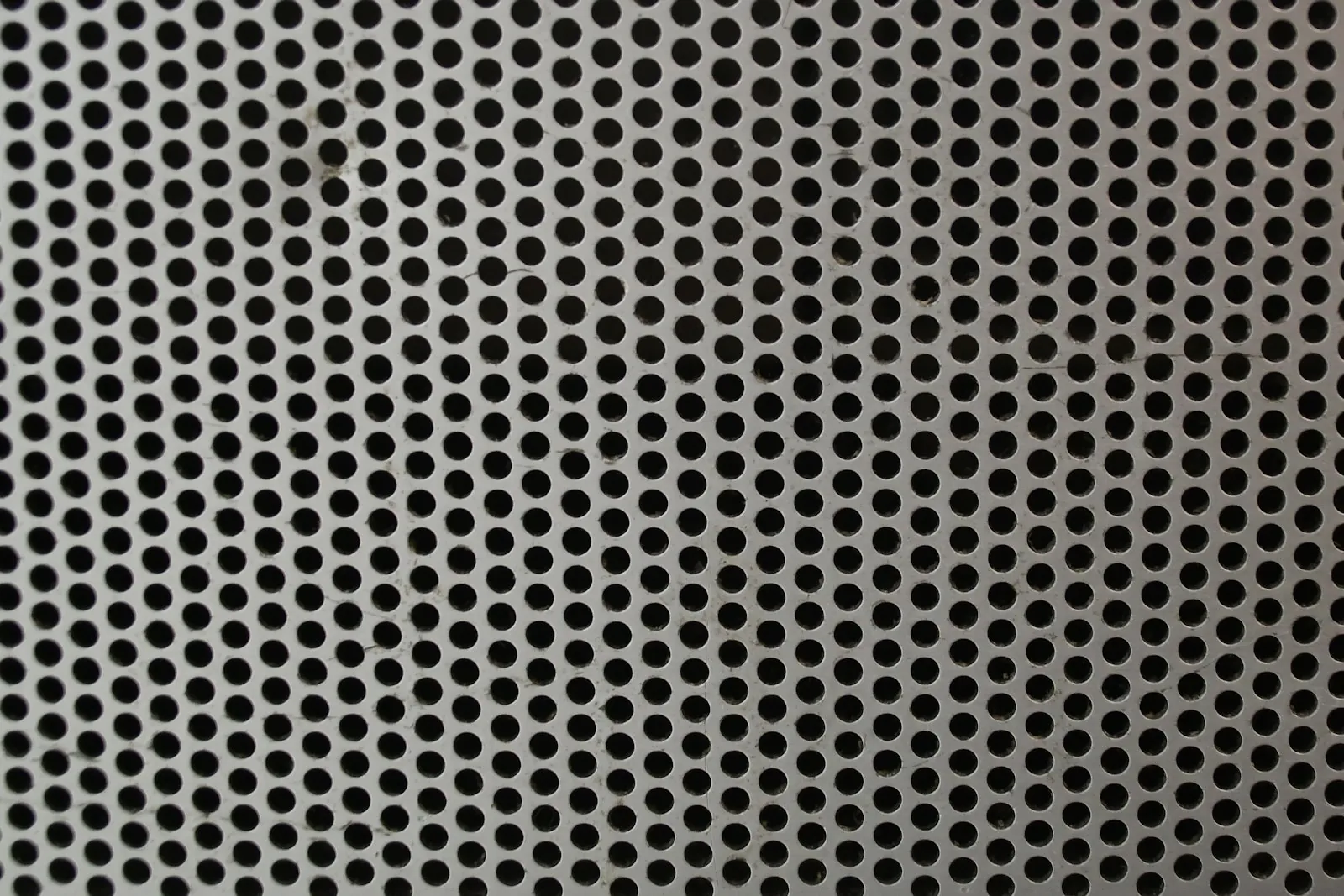
Layers from back to front
- 1 mm aluminium back sheet
- LED lights
- PC diffuser
- 1 to 2 mm perforated aluminium sheet
Forms
3D form structures
Each 3D form is built over a framed structure, then covered in stretch or printed film.
Pillar form
Illuminated pillar that combines looks and function. Built from 1 / 1.5 inch square tube with an H profile.
Cube form
Light radiating from all six sides. Built from 1 / 1.5 inch square tube with an H profile.
Wave form
A wavy, flowing design. Built from 1 / 1.5 inch square tube, W and F profiles, 19 mm and 12 mm plywood and stretch fabric.
Dome form
Inward and outward domes. Built from 1 / 1.5 inch square tube with W and F profiles.
Pyramid form
A pyramid-shaped ceiling form. Built from 1 / 1.5 inch square tube, 8 / 10 mm MS rod, H profile and ACP or aluminium sheet.
Start a project
Need a specification for your project?
Tell us the room and the ceiling type. We confirm the exact specification in writing with your quote.